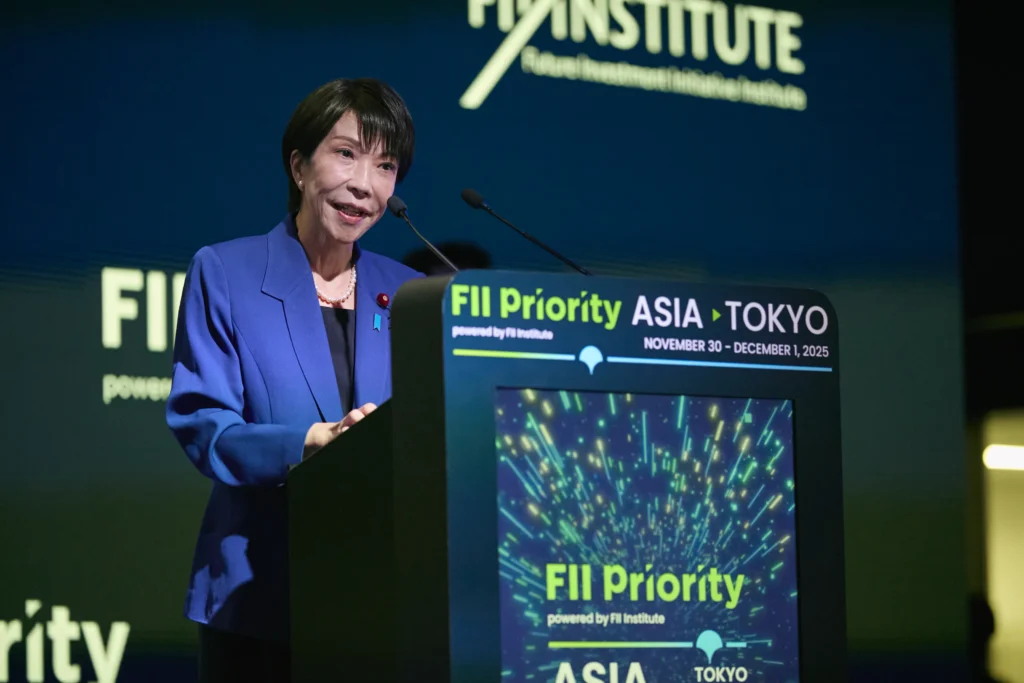
Tokyo, Japan – December 2, 2025 – The inaugural FII PRIORITY Asia Summit wrapped up in Tokyo following two days of high-level discussions involving more than 1,200 global leaders, policymakers, corporate executives, investors, and innovators. The event focused on Japan’s evolving economic strategy and its role in driving transformation across Asia. n nWith over 40 sessions spanning plenary panels, thematic workshops, and private roundtables, the summit gathered international stakeholders under the theme “The New Asia” to assess regional growth patterns, technological advancements, and emerging investment frameworks. n nRichard Attias, Chairman of the Executive Committee and Acting CEO of the FII Institute, opened the summit by emphasizing Japan’s central position in the global economy: “Asia is becoming the core of global economic momentum, and Japan is leading this shift through resilience, innovation, and strategic foresight.” n nH.E. Yuriko Koike, Governor of Tokyo, reinforced the city’s status as a strategic entry point for international business: “Tokyo offers a dynamic environment for investment, combining financial strength, technological advancement, cultural influence, and sustainable urban development.” n nJapan’s new administration presented a cohesive plan for an innovation-driven, outward-looking economy. In her first appearance at an FII event, Prime Minister H.E. Sanae Takaichi outlined her government’s diplomatic and fiscal priorities: “The Takaichi Cabinet aims to place Japanese diplomacy at the heart of international discourse by collaborating with nations that share our values.” She also stressed efforts to boost long-term economic growth and strengthen trust in Japan’s fiscal policies. n nH.E. Satsuki Katayama, Minister of Finance, elaborated on Japan’s pivot toward innovation-based development: “We have established a new investment structure targeting key sectors such as quantum computing and space exploration.” This vision was supported by top financial executives. n nAkihiro Fukutome, President and CEO of SMBC Group, stated: “Japan has a strong history of technological endurance and is now navigating major shifts related to demographics, climate change, and digital evolution.” n nKanetsugu Mike, Chairman of MUFG, highlighted the financial requirements of large-scale technological progress: “We need scalable solutions for affordable energy and funding mechanisms aligned with our net-zero goals.” n nIn a notable exchange, H.E. Yasir Al-Rumayyan, Governor of the Public Investment Fund (PIF) and Chairman of the FII Institute’s Board of Trustees, discussed expanding economic cooperation between Saudi Arabia and Japan with Masahiro Kihara, President and Group CEO of Mizuho Financial Group. Al-Rumayyan emphasized Asia’s role beyond traditional sectors: “Asia is where global innovation thrives—we aim to deepen our partnerships and improve collaboration in procurement and technology.” n nThe gaming industry, a major cultural and economic force in Japan, was spotlighted in a dialogue between H.R.H. Prince Faisal bin Bandar bin Sultan Al Saud, Chairman of the Saudi Esports Federation, and Haruki Satomi, President and Group CEO of SEGA SAMMY Holdings. Prince Faisal noted the immersive nature of digital entertainment: “Games are not just consumed—they are lived. Unlike books or films, they offer first-person engagement, making them a powerful cultural vehicle.” n nSmaller, focused sessions examined advances in health tech, cross-border financial systems, asset management, and next-generation innovation. A specialized lab on AI, Deep Tech, and Venture Vanguard brought together scientists, entrepreneurs, and financiers to evaluate Asia’s growing influence in cutting-edge research. n nLater in the program, H.E. Abdullah Fahad Bin Zarah, Deputy Minister for Economic and Development Affairs at Saudi Arabia’s Ministry of Foreign Affairs, joined former Italian Prime Minister Matteo Renzi and Richard Attias in analyzing global economic realignments, capital movements, and shifting geopolitical relationships. Bin Zarah observed: “The world has never been more economically interconnected. The Kingdom is transforming its stability and financial capacity into global influence. Today’s discussions show that Saudi Arabia can serve as both a stabilizing force and a source of capital during uncertain times.” n nThe summit closed with a keynote conversation between Masayoshi Son, Chairman and CEO of SoftBank Group Corp., and Richard Attias, focusing on the trajectory of the Asian century—an era defined by artificial intelligence, global connectivity, and vast opportunity. Son expressed confidence in AI’s potential: “Once artificial intelligence reaches advanced levels, there’s no inherent reason for it to pose a threat to humanity.” n n— news from FII Institute
— News Original —
FII PRIORITY Asia concludes landmark Tokyo first edition, spotlighting a new economic direction for Japan and the rise of the New Asia
Tokyo, Japan – December 2, 2025 – The FII PRIORITY Asia Summit concluded in Tokyo after two days of high-level strategic dialogue, convening over 1,200 global leaders, policymakers, CEOs, investors, and innovators to examine how Japan and the broader Asian region are reshaping global economic, technological, and diplomatic systems. n nThe summit featured more than 40 sessions across plenaries, thematic labs, and closed-door conclaves. Under the banner “The New Asia,” the 1,200 participants explored the region’s growth trajectory, technological frontier, and new investment alliances. n nOpening the summit, Richard Attias, Chairman of the Executive Committee & Acting CEO of the FII Institute, underscored Japan’s pivotal global role: “Asia is the gravitational center of the global economy, and Japan stands at its heart, guiding the region with resilience, creativity, and wisdom.” n nH.E. Yuriko Koike, Governor of Tokyo, reaffirmed the city’s position as a gateway to global markets: “Tokyo is the perfect global investment hub,” highlighting its leadership in resilient finance, innovation, cultural vitality, and sustainable urban systems. n nJapan’s newly formed government outlined a unified vision for an outward looking, innovation powered, investment driven economy. Prime Minister H.E. Sanae Takaichi, in her first FII address, articulated Japan’s diplomatic and fiscal direction: “The Takaichi Cabinet seeks to position Japanese diplomacy at the center of global dialogue by working closely with like-minded nations.” She emphasized plans to raise Japan’s economic growth potential and reinforce global confidence in its public finances. n nH.E. Satsuki Katayama, Minister of Finance, detailed Japan’s shift toward innovation-led growth: “Japan has introduced a new investment framework for strategic sectors, including quantum technology and space.” This message was echoed by Japan’s leading financial institutions. n nAkihiro Fukutome, President & CEO of SMBC Group, noted: “Japan has built a legacy of technological resilience and now stands at the frontier of demographic, climate, and digital transformation.” n nKanetsugu Mike, Chairman of MUFG, emphasized the scale of the opportunity ahead: “We need technology that delivers affordable power at scale, and we require financing to meet our net-zero ambition.” n nIn a wide-ranging conversation, H.E. Yasir Al-Rumayyan, Governor of the Public Investment Fund (PIF) and Chairman of the Board of Trustees of FII Institute, highlighted the depth of Saudi–Japan economic ties with Masahiro Kihara, President & Group CEO of Mizuho Financial Group, Al-Rumayyan assured: “Asia represents far more to us than energy and agriculture. It’s where most of the innovations in the world are initiated, and we want to have better ties with Asia and better procurement processes between us.” n nGaming, one of Japan’s most influential creative industries—took center stage in a fireside dialogue between H.R.H. Prince Faisal bin Bandar bin Sultan Al Saud, Chairman of the Saudi Esports Federation, and Haruki Satomi, President & Group CEO, SEGA SAMMY Holdings. Prince Faisal described gaming’s cultural weight: “Gaming is a powerful cultural export. Films and books are passive, but games are experienced in first person.” n nOver the two days, intimate labs explored health innovation, asset management, cross-border finance, and next-generation technologies. A dedicated AI, Deep Tech & Venture Vanguard Lab brought together frontier scientists, inventors, and investors to assess how Asia is becoming a global center for breakthrough innovation. n nIn the afternoon, H.E. Abdullah Fahad Bin Zarah, Deputy Minister for Economic and Development Affairs, Ministry of Foreign Affairs Saudi Arabia, Senator and former Prime Minister Matteo Renzi, and Richard Attias examined shifting global power dynamics, new capital flows, and evolving geopolitical alliances. As Bin Zarah noted: “Economic interdependence has reached heights unprecedented in modern history. The Kingdom has chosen to convert stability and investment into real global reach. What we have seen today is that Saudi Arabia offers both a source of stability and of capital at a time when the world needs both.” n nThe summit concluded with a much-anticipated conversation between Masayoshi Son, Chairman & CEO of SoftBank Group Corp., and Richard Attias on the future of the Asian century, AI-driven, globally interlinked, and rich with opportunity. Son expressed optimism about the future of artificial intelligence: “When AI becomes so smart, there’s no reason for that super intelligence to be harmful to humans.” n n-ends- n nAbout FII Institute n nThe FII Institute is a global nonprofit foundation with an investment arm and one agenda: Impact on Humanity. Through its THINK, XCHANGE, and ACT pillars, the Institute fosters great ideas, empowers innovators, and invests in scalable solutions across critical sectors, including AI and robotics, sustainability, healthcare, and education. n nFor more information, please visit: https://fii-institute.org/