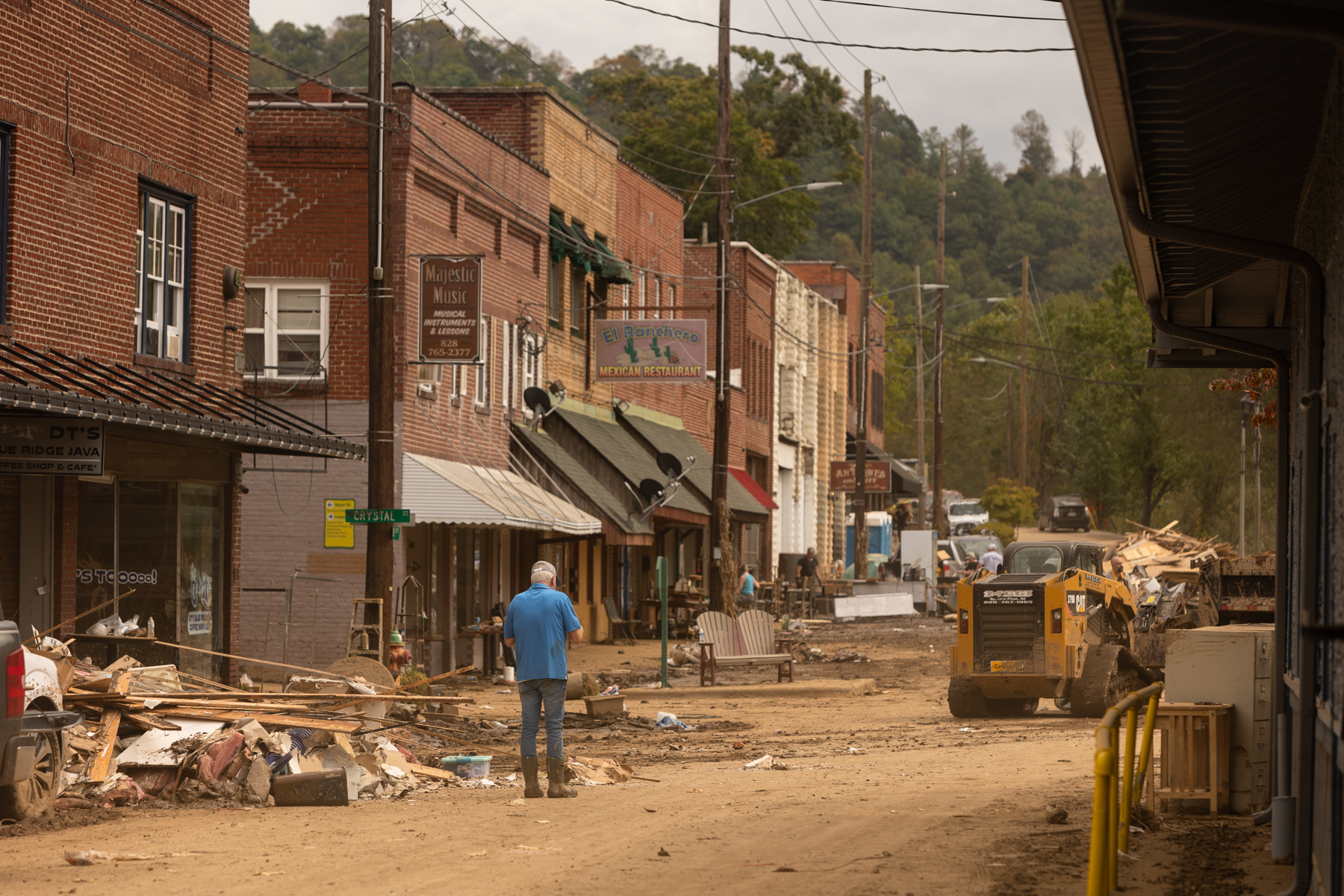
The aftermath of Hurricane Helene has officially altered North Carolina’s economic landscape, with six Western North Carolina counties now classified as more economically distressed in the state’s 2026 tier designations. The updated rankings, released last week, determine eligibility for state development aid and reflect both the storm’s tangible damage and structural flaws in the classification system.
North Carolina uses a tiered model to assess county economic health, dividing its 100 counties into three groups: Tier 1 (most distressed), Tier 2 (moderate distress), and Tier 3 (least distressed). Each year, exactly 40 counties are assigned to Tier 1 and Tier 2, and 20 to Tier 3, regardless of statewide economic trends. This fixed structure means that declines in one region can artificially elevate others, even if their conditions haven’t improved.
The 2026 rankings incorporate data from various years: unemployment and property tax base per capita are from 2025, population growth spans 2021–2024, and median household income reflects 2023 figures. This lag means some long-term effects of Helene—such as property devaluation and population loss—may not appear for several years.
Counties shifting to higher distress levels include Buncombe, Burke, Haywood, Henderson, Madison, and Yancey. Their reclassification stems largely from spikes in unemployment following the storm, a factor particularly sensitive due to its one-year averaging method. Henderson County dropped from Tier 3 to Tier 2 for the first time in over a decade, despite signs of recovery already emerging.
Lillian Govus, communications director for Buncombe County, acknowledged the rankings capture real hardship but noted the temporary nature of some indicators. Access to increased state funding could aid long-term recovery efforts. However, Brittany Brady of the Henderson County Economic Development Partnership criticized the rigidity of the system, pointing out that being just outside the top 20 excludes them from certain grants, even if economic conditions stabilize.
Some counties saw contradictory movements. Graham and Macon in western North Carolina improved in rankings due to rising property tax bases—possibly linked to vacation homes or retiree influx—despite incomes remaining below state averages. Meanwhile, Pasquotank County moved from Tier 2 to Tier 1 despite three of four economic indicators improving, highlighting how the fixed quota distorts outcomes.
Volatility is common among counties near tier boundaries. Surry County, for instance, has shifted between Tier 1 and Tier 2 seven times in 12 years, suggesting the system captures statistical noise rather than meaningful change. Brian Barnett, Davie County manager, expressed mixed feelings about his county’s move to Tier 3, noting it reduces access to enhanced funding despite minimal actual improvement.
Conversely, Granville County welcomed its return to Tier 2, as it restores eligibility for certain business incentives. Charla Duncan, the county’s economic development director, explained that dropping a tier can actually benefit existing industries by reopening funding pathways.
A persistent issue remains in eastern North Carolina, where 20 counties have remained in Tier 1 since the system began, showing no signs of upward mobility. Dalton Bailey of the NC Rural Center noted that current support mechanisms appear insufficient to reverse long-term stagnation in these areas.
— news from Carolina Public Press
— News Original —
Helene’s devastation shakes up NC economic distress tiers for 2026
The economic devastation wrought by Hurricane Helene is now official in the eyes of the state. Six Western North Carolina counties are now considered more economically distressed than they were in 2025, according to North Carolina’s unique system of economic distress tiers, which ranks and sorts each county in the state.
North Carolina’s 2026 economic distress designations were released last week, reshuffling which counties qualify for development aid. Carolina Public Press examined conditions in the 18 counties that shifted tiers to see how well the system reflects economic reality and whether the system addresses county officials’ concerns.
Some of the new tier designations accurately indicate the economic disaster of Helene. Others, though, reflect serious structural issues with the design of the state program.
Those downward shifts in Western NC artificially inflated the rankings of other counties where conditions haven’t drastically changed, affecting their eligibility for state funding. Plus, half of the counties that changed tiers also changed designations last year, compounding a yo-yo effect that complicates economic planning.
What are distress tiers?
In theory, Tier 1 is home to the most economically distressed counties. Tier 2 represents medium distress, and Tier 3 the least distressed. Department of Commerce officials apply four criteria to determine which counties are placed in which tier:
Unemployment rate
Population growth
Median household income
Property tax base per capita.
Each year, there must be 40 Tier 1 counties, 40 Tier 2 counties and 20 Tier 3 counties — regardless of overall progress or decline in the state or local economies. This is a central assumption from which many of the system’s issues stem.
The state uses the tiers in order to more prudently distribute its limited money to the counties that need it most. The funding that is officially impacted by tier designations includes public infrastructure grants, competitive business incentive programs and building redevelopment funds. However, many more state programs now rely on the tier system — including several noneconomic programs.
The idea is that Tier 1 counties need the money more but have less resources to compete for it. They need the extra help. But due to a number of systemic issues, counties that need help don’t always get it, and changes in tier rank are often arbitrary.
One issue is that each of the economic indicators used in the tiers formula come from different time periods.
For the 2026 rankings, property tax base per capita and unemployment rate are measured in 2025, while population growth is measured from 2021 to 2024. The median household income comes from 2023.
Helene’s delayed effect
The destruction of Helene is finally showing up in state economic data, and six Western NC counties will shift to a more distressed designation in 2026 as a result. Macon County is now the only western county not classified as economically distressed.
The Western NC counties shifting to more distressed tiers include Buncombe, Burke, Haywood, Henderson, Madison and Yancey. These counties will now be eligible for more generous state funding.
“Certainly the impacts from Helene are far-ranging, and its impacts to unemployment and population growth are present in these rankings,” Buncombe County communications director Lillian Govus told CPP.
“While it may be a temporary shift, the ability to access more state funding can benefit our whole community as we continue the long-term work of disaster recovery.”
Although Buncombe fell in the tier rankings, two out of four of its factors actually improved. Plus, according to the population data available this year, growth remained healthy.
For most of these counties, a spiked unemployment rate in the wake of the storm was the decisive factor. The unemployment rate is often the most volatile factor in the rankings. That rate is measured on a fairly up-to-date one-year average, instead of over multiple years or on a large delay like other factors.
Henderson County fell from Tier 3 — or the least economically distressed category — for the first time in more than a decade.
“The tier system unfortunately puts 20 counties in Tier 3, instead of having a threshold,” said Brittany Brady, president of the Henderson County Economic Development Partnership.
“We’ve been fortunately or unfortunately in that top 20 for as long as I’ve been in economic development — 15 years. This year, we were just two places away from being in the 20. And our numbers have already kind of leveled back out. So we’ll see what happens next year, if we shift back into that 20. We have to learn what opportunities await us in Tier 2, and then if we were to shift back, unfortunately, a lot of those grants would no longer be at our discretion.
“But the tier system is difficult, because you’ve got different pockets in the community that may need different things. When you are tied overall to a county ranking, sometimes that puts you in a difficult position of not being able to get resources in the most desperate parts of your community because there’s something else that’s pulling those averages in a different direction.”
According to Dalton Bailey, research and data manager at the NC Rural Center, it will be important to follow how these counties continue to move in the tiers over the next several years. The indicators lag behind so much that some of the economic effects of the storm — like changing property value, population decline, and falling incomes — won’t be visible for years to come.
Graham and Macon counties in the far west actually rose in the rankings this year. Both of these counties saw big increases in their property tax base per capita, indicating that the mountain counties are still popular locales for vacation homes or wealthy retirees. The median household income in these counties, however, is still well-below the state average.
Those Tier 3 western counties that fell into lower tiers this year — think Buncombe, Henderson, and Haywood — pushed other counties up into tiers where they don’t necessarily belong.
“Everybody knew the counties in Western North Carolina were going to have some downward movement in their ranking this year because of Hurricane Helene,” Davie County manager Brian Barnett said. “But that played some role in the movement of all counties this year.”
Dancing at the line
Half of the counties that changed tiers this year shifted last year as well. Some counties change so frequently that the tier system becomes basically meaningless. In these counties that hover around the tier boundaries, the system measures statistical noise rather than meaningful economic change.
Take Surry County, for example. Surry has shifted between Tier 1 and Tier 2 seven times in just over a decade. It shifted once again this time around.
“We dance at the line,” Blake Moyer, Surry County economic development director, told CPP. “To me, it’s indicative that there really hasn’t been that much change. It’s hard to really pull too much out of the ranking.”
Still, the year-to-year volatility in tiers makes it difficult to know what kind of state assistance to expect in any given year.
Other counties experienced virtually no change whatsoever, or even change in the opposite direction of how they moved in the tier rankings, underscoring the absurdity of the designations.
In Pasquotank County, three out of four of the economic indicators improved, and the population growth rate there only slowed by 0.3%. Still, Pasquotank moved from Tier 2 to Tier 1, likely because of some other county taking a spot in Tier 1.
Beaufort County experienced hardly any meaningful changes in its economic outlook and moved into Tier 2 from Tier 1.
Discouraged by tiers progress
Though typically seen as a good thing, counties that shift to Tier 3 from other tiers miss out on enhanced state dollars. This creates a kind of backwards incentive to remain economically distressed. This year, four counties shifted from Tier 2 to Tier 3: Macon, Stanly, Camden and Davie.
Barnett, the manager of Davie County, isn’t all that excited about moving to Tier 3.
“We are glad we are scoring as a less-distressed county,” Barnett said of the tiers.
“But we didn’t experience that much change, and yet, that puts us into a different bracket when it comes to an opportunity for grant funding. It doesn’t mean we’ll lose out on a grant altogether, it just means we won’t get as much grant funding as someone else.”
Davie County’s median household income did rise by more than 18% in this year’s dataset, which is actually based on 2023 numbers. Barnett doesn’t know what might have caused that substantial increase.
Even with that encouraging number, Barnett doesn’t feel Davie is economically equal to other counties in Tier 3, with heavy hitters such as Wake County, home to Raleigh, and Mecklenburg County, home to Charlotte.
“We are glad to be in a pool with some of the bigger, more prosperous counties,” Barnett said. “I’m not necessarily saying we are one of them, but it’s good to know that we’re competing with them. It’s like being a college sports team where we’re division one, but we understand we’re not Alabama football.”
Conversely, switching tiers downward can be welcome at times. Officials in Granville County are relieved to fall back to Tier 2 in 2026.
“That shift from Tier 2 to Tier 3 is actually something economic developers cringe at a little bit,” said Charla Duncan, Granville County economic development director.
“It changes how you’re able to access state funding for business recruitment and for building expansion. In my world, us going back down to Tier 2 actually keeps some doors open, particularly for our existing industries.”
Continued stagnation in the bottom 20
A group of 20 counties are stuck at the bottom of the rankings, and have been since the tiers system’s inception.
Most of these counties are located in two distinct clusters in Eastern NC.
Once again, nothing changed for these counties in the 2026 rankings. The system just isn’t equipped to address the persistent economic stagnation in this region.
“These places are not making improvements at the same rate as the rest of North Carolina,” Bailey of the NC Rural Center said.
“Obviously, it seems like whatever assistance is going to those counties is not enough, because we’re not seeing improvements or anything like that.”
Related