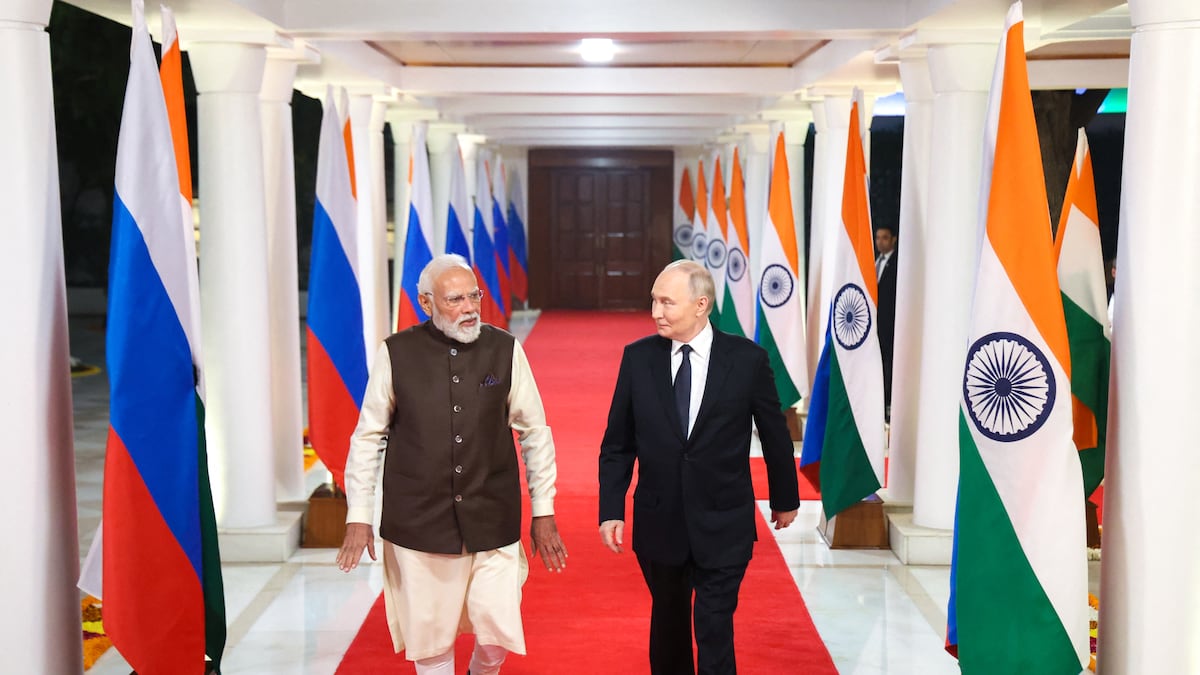
Indian Prime Minister Narendra Modi welcomed Russian President Vladimir Putin with a personal airport pickup and a symbolic limousine ride, marking the beginning of a high-profile two-day summit in New Delhi. The visit, notable for its warm reception despite international scrutiny over Russia’s ongoing conflict in Ukraine, underscored India’s commitment to maintaining strategic autonomy in foreign affairs. Public displays such as devotional lamps spelling “Welcome Putin” along the Ganges River highlighted the diplomatic significance of the occasion.
The discussions culminated in agreements aimed at deepening bilateral economic ties, including facilitating greater labor mobility by enabling more Indian citizens to work in Russia. Putin affirmed Moscow’s readiness to ensure continuous fuel supplies to support India’s rapidly expanding economy, reinforcing energy cooperation between the two nations.
Since Russia’s invasion of Ukraine, India has become one of the largest importers of discounted Russian crude oil, refining and re-exporting some of it globally. However, recent U.S. tariff hikes—from 25% to 50%—and sanctions targeting Kremlin-linked energy firms have prompted Indian refiners like Reliance Industries to scale back purchases. These actions were partly driven by compliance concerns related to an EU ban on refined products derived from Russian crude when processed in third countries such as India.
Despite external pressures, Indian officials have maintained that their energy procurement decisions are based on economic rationale rather than geopolitical alignment. Officials note that Western nations, including members of the European Union and the United States, continue to import Russian energy products, calling demands for India to halt purchases “unreasonable.”
Analysts observe that India is navigating a complex balancing act—preserving its historic defense and energy relationship with Moscow while simultaneously enhancing strategic partnerships with Western democracies. Although Russia remains a critical supplier of military equipment and fossil fuels, experts suggest the trajectory of India-Russia relations may gradually shift toward a more limited, managed engagement over time.
Even amid tensions with the Trump administration, defense collaboration between India and the U.S. remains robust. This year alone, the two countries have conducted five joint military exercises, reflecting deepening operational coordination. As Swaran Singh, an international relations scholar, noted, Putin’s ability to travel to the world’s largest democracy carries symbolic weight, especially given the International Criminal Court’s arrest warrant issued against him in March 2023.
While trade between India and Russia is projected to reach $100 billion, current flows remain heavily skewed toward Indian imports of Russian oil and arms. Modi made passing reference to the war in Ukraine, describing it as “the situation in Ukraine” and expressing support for peaceful resolution efforts—though he did not explicitly endorse any specific diplomatic initiative, including those led by the Trump administration.
— news from Oregon Public Broadcasting – OPB
— News Original —
Putin and Modi expand India-Russia economic ties in talks in New Delhi
There was a hug and selfie in a limousine ride after Indian Prime Minister Narendra Modi personally picked up Russian President Vladimir Putin on arrival in the capital New Delhi on Thursday evening. Devotional lamps spelled out “Welcome Putin” during an evening prayer at the Ganges River that was shared online. There was an honor guard and a brass band.
India was warmly welcoming Putin for his first visit since his country invaded Ukraine nearly four years ago. The visit in part signaled India’s defiance to the Trump administration, which has punished, and publicly humiliated, New Delhi for its purchases of Russian oil.
“The message first and foremost is that India has options,” said Chietigj Bajpaee, senior research fellow for South Asia at Chatham House. “It is an effort to reaffirm the India-Russia relationship at a time when India has been under growing pressure to sever that relationship, or at least downgrade it in some ways.”
India has long prided itself on its independent foreign policy, but grew close to Russia decades ago, when it was the dominant part of the Soviet Union. The policy came in response to a sense of being cornered on its northern borders: Pakistan firmly allied itself with the U.S., and in the early 1970s, facilitated an opening in relations between Washington and Beijing. India and China share more than 2,000 miles of disputed border across the Himalayas.
The two-day meeting that began Thursday in New Delhi was a boon to Putin, whose travels have been largely curtailed since the International Criminal Court issued an arrest warrant against him in March 2023. “To visit the world’s largest democracy and a large country like India, will bring him enormous global attention in that sense,” said Swaran Singh, who writes on international relations.
After a bilateral meeting on Friday, where both sides announced a deal to allow more Indian nationals to work in Russia, Putin said in prepared statements through a translator that his country was “ready to continue uninterrupted shipments of fuel for the fast growing Indian economy.”
Russian oil in focus
India had ramped up its purchasing of Russian oil after the invasion of Ukraine, and is now one of the world’s biggest buyers. It also sells Russian oil products onwards.
But Indian companies curbed their purchases of Russian oil in recent weeks, after the Trump administration punitively doubled its tariffs on India to 50% and American sanctions were imposed on Kremlin-linked Russian oil producers.
Most prominently, India’s biggest importer of Russian crude oil, Reliance Industries stopped purchasing Russian crude oil for its export products, Reuters reported in late November. That was to remain in compliance with a new European Union ban on imports of refined products made from Russian crude from some third countries, including India.
It is unclear how Putin can continue uninterrupted shipments of fuel to India amid sanctions and tariffs. But the Finnish-based Centre for Research on Energy and Clean Air reports there has been an increase in sanctions-avoiding behavior by vessels shipping Russian oil on the high seas, in part through flying flags that have been fraudulently obtained to conceal their operations. Previously India has described the pressure to cut its purchases of Russian oil as “unreasonable,” noting that both the European Union and the United States also purchase Russian energy products.
Treading a fine line
India has been stepping up purchases of U.S. oil and natural gas — which some analysts have interpreted as a sop to the Trump administration — and, to narrow its trade deficit with the U.S., also sought to purchase more U.S. energy products.
“India is navigating a difficult path,” said Bajpaee of Chatham House. “It’s trying to maintain close relations with Moscow and at the same time deepen engagement with the West.”
Perhaps to that end, in the Indian prime minister’s prepared statements, he nodded to Russia’s invasion, describing it as “the situation in Ukraine.” He added, “We welcome all efforts being made for a peaceful and lasting resolution in this matter. India has always been, and will always be ready to contribute.”
It wasn’t clear, however, if Modi was referring to the Trump administration’s current efforts to end the war. On Tuesday, Trump’s special envoy Steve Witkoff and son-in-law Jared Kushner met with Putin and his team for five hours. But Putin told the news outlet India Today on Thursday that “we can’t agree to” some of the administration’s proposals, without giving further details. When pressed on the matter during the same interview, he said through a translator: “I doubt it would interest you to hear about it as it lasted five hours. … Five hours is too much.”
Russia and India inked some deals during Putin’s visit, including one that would facilitate more Indians to work in Russia. There were vows that trade between the two would soon reach $100 billion — so far the trade is mostly one-way, and is dominated by India’s purchases of Russian fossil fuels.
And yet, the U.S. remains a far more forward-looking and important relationship, said Bajpaee of Chatham House. “Russia remains a key strategic partner. India does not want to sever that relationship with Moscow and it particularly doesn’t want to do that under U.S. or Western pressure,” he said. “But the direction of travel, I would argue, is towards a managed decline.”
He noted, despite the tensions between India and the U.S. under the Trump administration, “there’s very strong linkages and functional cooperation between India and the U.S. So despite the bad blood, India conducts more joint military exercises with the U.S. than with any other country. They’ve conducted five military exercises just this year.”