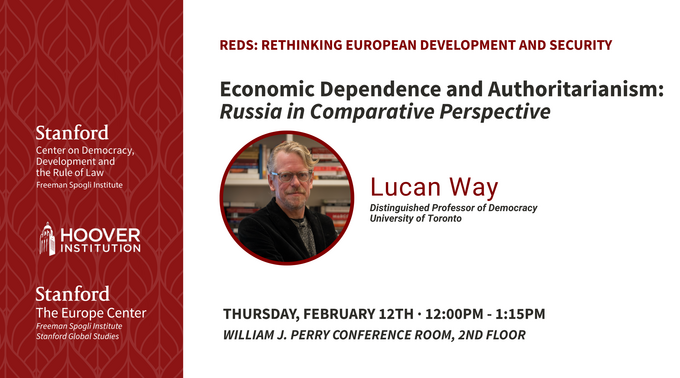
A new academic study by Semuhi Sinanoglu, Lucan Way, and Steven Levitsky explores how state control over economic resources contributes to the persistence of authoritarian regimes. Through statistical analysis and case studies of Belarus, Russia, Kuwait, Togo, and Burundi, the authors argue that when citizens and businesses rely heavily on government-controlled economic assets, opposition movements lose financial independence, public support, and organizational strength. This dependence arises from various conditions—such as state-dominated economies, oil wealth, or extreme underdevelopment—and is a key factor behind the endurance of closed autocracies. The research suggests that economic reliance on the state undermines pluralism and entrenches autocratic rule by limiting alternative sources of power.
Lucan Way, a political science scholar with a PhD from the University of California, Berkeley, has extensively researched global patterns of democracy and dictatorship. His recent co-authored book, Revolution and Dictatorship: The Violent Origins of Durable Authoritarianism, examines why regimes born from violent revolutions—like those in China, Cuba, and the former USSR—have proven exceptionally resilient. In his solo work, Pluralism by Default, Way argues that competitive politics in some post-Soviet states emerged not from strong democratic institutions, but from weak and fragmented authoritarian governments unable to fully monopolize power. His earlier collaboration with Steven Levitsky, Competitive Authoritarianism, became a foundational text in the study of hybrid regimes and has influenced a broad range of research on semi-democratic systems.
Way’s research has appeared in leading journals such as World Politics, American Journal of Political Science, and Journal of Democracy. His 2005 article in World Politics received the Best Article Award from the American Political Science Association’s Comparative Democratization section in 2006. He currently serves as Co-Director of the Petro Jacyk Program for the Study of Ukraine and Co-Chair of the Editorial Board of The Journal of Democracy. He has held fellowships at Harvard University and the University of Notre Dame.
— news from Freeman Spogli Institute for International Studies
— News Original —
Lucan Way | REDS Seminar: Economic Dependence and Authoritarianism: Russia in Comparative Perspective
Drawing on a statistical analysis and case studies, Semuhi Sinanoglu, Lucan Way and Steven Levitsky argue that incumbent control over the economy fosters authoritarianism by undermining the popular, financial and organizational bases of opposition activity. The concentration of economic resources in the hands of state leaders – whether it emerges out of statist economic policies, oil wealth, or extreme underdevelopment – makes citizens and economic actors dependent on the whim of state leaders for survival. Indeed, poor, statist and/or oil rich states account for the overwhelming share of closed autocracies today. To establish the plausibility that economic dependence is a major source of authoritarianism, the paper presents a statistical analysis of authoritarian durability and evidence from four diverse cases – Belarus, Russia, Kuwait, Togo, Burundi — that such dependence has weakened opposition. n nLucan Ahmad Way received his BA from Harvard College and his PhD from the University of California, Berkeley. Way’s research focuses on global patterns of democracy and dictatorship. His most recent book (with Steven Levitsky), Revolution and Dictatorship: The Violent Origins of Durable Authoritarianism (Princeton University Press) provides a comparative historical explanation for the extraordinary durability of autocracies (China, Cuba, USSR) born of violent social revolution. Way’s solo-authored book, Pluralism by Default: Weak Autocrats and the Rise of Competitive Politics (Johns Hopkins, 2015), examines the sources of political competition in the former Soviet Union. Way argues that pluralism in the developing world often emerges out of authoritarian weakness: governments are too fragmented and states too weak to monopolize political control. His first book, Competitive Authoritarianism: Hybrid Regimes after the Cold War (with Steven Levitsky), was published in 2010 by Cambridge University Press. Way’s work on competitive authoritarianism has been cited thousands of times and helped stimulate new and wide-ranging research into the dynamics of hybrid democratic-authoritarian rule. n nWay also has published articles in the American Journal of Political Science, Comparative Politics, Journal of Democracy, Perspectives on Politics, Politics & Society, Slavic Review, Studies in Comparative and International Development, World Politics, as well as in a number of area studies journals and edited volumes. His 2005 article in World Politics was awarded the Best Article Award in the “Comparative Democratization” section of the American Political Science Association in 2006. He is Co-Director of the Petro Jacyk Program for the Study of Ukraine and is Co-Chair of the Editorial Board of The Journal of Democracy. He has held fellowships at Harvard University (Harvard Academy and Davis Center for Russian and Eurasian Studies), and the University of Notre Dame (Kellogg Fellowship).