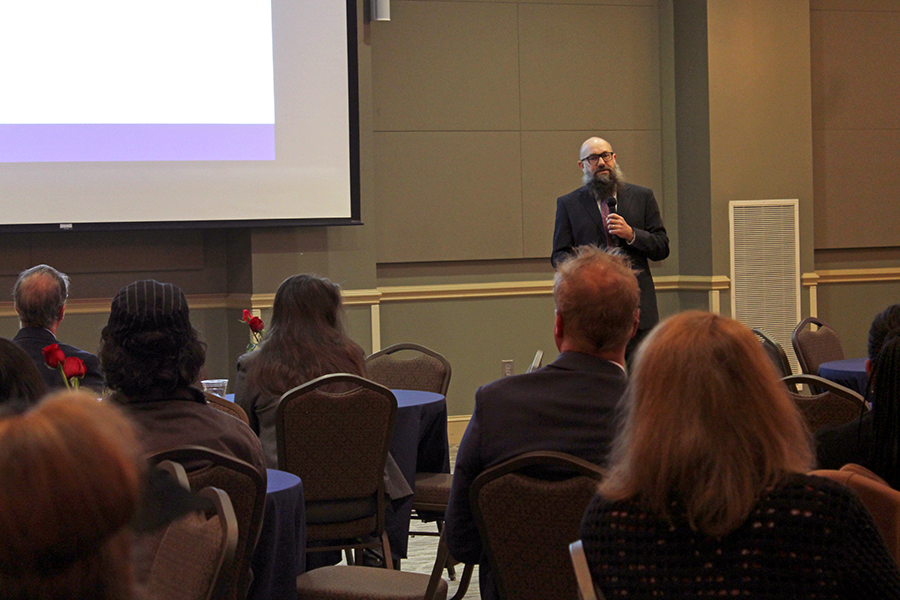
The 18th annual Economic Forecast Breakfast at Augusta University, held on December 2, offered insights into regional and state economic trends, highlighting both progress and persistent challenges. Economist and Hull College of Business professor Simon Medcalfe led the event, which is supported by a Wells Fargo endowment and draws attendees from academia, business, and local government. He began by explaining the difference between nominal and real gross domestic product (GDP), noting that Augusta’s nominal GDP stands at approximately $37 billion. However, after adjusting for inflation, real GDP growth in the area has averaged about 1.5% annually since 2001—slightly below the national average of 2.2%.
Medcalfe pointed out that Richmond County accounts for 44% of the region’s economic output, while Columbia and Burke counties have each doubled their real GDP over the past 25 years, signaling strong growth in those areas.
Undergraduate researchers Kacey Axon and Brandon Day contributed to this year’s analysis. Axon examined disparities in economic growth across Georgia’s counties, finding that regions with higher income inequality tend to grow more slowly due to limited access to opportunity. Her research indicated that education access and industry diversity are stronger predictors of reduced inequality than commonly cited factors like tax policy or minimum wage.
She noted Georgia’s strong performance in early childhood education, ranking among the top 10 states for preschool access, but stressed the need to expand educational opportunities in rural areas and continue diversifying the economy. The state’s film industry, which has created thousands of jobs since the early 2000s, was cited as a successful model of sector diversification.
Day analyzed the impact of tariffs on employment in Georgia from 2009 to 2023. He found that while higher tariffs correlate with modest gains in manufacturing and agriculture employment, they are offset by declines in the service sector. He emphasized that changes in trade policy take time to affect the economy, with a typical lag of about three years, meaning tariffs are not a primary driver of employment trends. Instead, overall economic health plays a more decisive role.
Medcalfe also discussed new data from the Bureau of Economic Analysis on research and development (R&D) spending. Georgia ranks 16th nationally in R&D investment, with spending doubling over the past decade—most of it in the last five years. South Carolina ranks 29th but shows similar upward momentum. Eighty-six percent of Georgia’s R&D is conducted by private entities, with 78% from businesses and 18% from higher education institutions like Augusta University. Notably, the state’s higher education sector spends more on R&D than the total research budgets of 14 other states.
University-led research has a particularly strong multiplier effect: a 1% increase in such spending correlates with a 1.6% rise in GDP, compared to a one-to-one relationship for business R&D, which tends to be more proprietary.
Looking ahead to 2026, Medcalfe identified inflation, trade policy uncertainty, and artificial intelligence as key concerns. While inflation has eased from its 2022 peak, recent tariff increases have contributed to renewed price pressures. Policy instability makes long-term planning difficult for businesses. Additionally, AI’s rapid advancement is affecting entry-level job markets, with unemployment among recent college graduates remaining above average since 2022.
“Overall, Augusta and Georgia are positioned well for economic growth in 2026 with a strong commitment to early childhood education, a diversified labor market and strong research and development. However, uncertainty abounds in national macroeconomic policy that could negatively impact growth next year,” Medcalfe concluded.
— news from Augusta University News
— News Original —
Annual Economic Forecast Breakfast offers snapshot of the local economy
When it comes to forecasts, whether in weather or economics, a lot of research on what has recently happened goes into attempting to predict what can happen, but it’s only as reliable as the data at hand. n nSimon Medcalfe, PhD, an economist and professor in Augusta University’s James M. Hull College of Business, hosted the 18th annual Economic Forecast Breakfast on Dec. 2. The event receives support from an endowment set up by Wells Fargo and draws attention from campus leadership, faculty, staff, students and members of the Augusta community. n nMedcalfe began the 2025 edition by walking the audience through the basics of economic growth by reviewing gross domestic product and real GDP. He emphasized that real GDP, which adjusts for inflation, offers a clearer picture of actual economic performance, and noted that the Augusta nominal GDP is currently about $37 billion. While nominal GDP appears to rise more steeply after 2020, much of that is driven by recent inflation. n n“That’s actually probably due to inflation that we’ve experienced over the last five-or-so years. If we subtract inflation out, we get real GDP, which is a better measure of economic growth because now we’re thinking about producing more goods and services, not just because those goods and services have gotten more expensive the last quarter of a century or so,” Medcalfe said. n nBy analyzing trends since 2001, Medcalfe highlighted that the Augusta area’s real GDP has grown at roughly 1.5% per year, slightly below the national average of 2.2%. He then broke GDP down by county, pointing out that Richmond County produces about 44% of the region’s economic output, followed by strong growth in Columbia and Burke counties, both of which have doubled their real GDP over the past 25 years. n nThis year, Medcalfe received some assistance in his data gathering and analyzing from two undergraduate students, Kacey Axon and Brandon Day, both seniors working toward their Bachelor of Business Administration with a concentration in economics. n nAxon presented her research on what factors contribute to economic growth varying so widely across Georgia. Using county-level data on per-capita income and gross domestic product, she showed that Georgia’s growth is “highly uneven,” with some counties expanding rapidly while others fall behind. This led her to investigate whether income inequality plays a role in that imbalance. n nHer findings showed counties with higher income inequality grow more slowly than those with lower inequality due to limited opportunities that suppress overall economic progress. n nTo better understand what drives income inequality, Axon expanded her analysis to the national level, examining factors like tax policy, minimum wage, education access and labor-market characteristics. Through her research, she found that education access and industry diversity are the strongest predictors of reduced inequality. n n“A lot of times when we’re thinking about income inequality, we think about things like tax policy and minimum wage being effective, but my results showed the opposite. It was education access and industry diversity that mattered for inequality,” Axon said. “So, what can Georgia do now? How can Georgia fix this?” n nAxon pointed to areas where Georgia is already performing well, noting how the state ranks among the top 10 nationally for preschool access, but she also emphasized the need to increase educational opportunities in rural counties and to further diversify Georgia’s industries. She highlighted the state’s growing film sector as a successful example of how new industries can strengthen the labor market and fuel growth. n n“When we think about the industries in Georgia, we sometimes think about agriculture, but Georgia has actually done a really great job developing a film industry since the early 2000s. This has created thousands of jobs and strengthened the labor market immensely,” she said. “If we can continue to diversify our industries, we’ll see more growth in Georgia. Overall, education access and industry diversity is what matters the most for Georgia’s growth. Reducing inequality will help Georgia grow.” n nDay focused his research on how tariffs influence employment across different sectors in Georgia, a topic he chose because, despite national debate on tariffs, there is limited research on their state-level impacts. His work examined data from 2009 to 2023, with broader context showing that U.S. tariff rates have steadily declined since the early 1990s, remaining around 2% except for a brief spike in 2018 tied to steel and aluminum tariffs. n nDay found that in Georgia, increases in tariffs are associated with slightly higher employment in manufacturing and agriculture. He also noted that tariff increases correlate with declines in service-sector employment, offsetting much of the gains seen in other industries. n nHe emphasized that tariff effects unfold slowly, with manufacturing decisions often taking three years to reflect changes in trade policy. Because of this lag, Day cautioned that tariffs are not a primary driver of employment trends. Instead, overall economic health plays a far bigger role in shaping sector growth. n n“It takes time before a lot of the changes are really realized. So, there is an average of a three-year lag before any changes to the rates are really seen affecting the economy overall,” Day said. “What I found with my research is the tariffs are not a primary driver for your employment trends. What we’re seeing is the general economic health of the area is going to be what really drives how employment trends are going. If the economic conditions are good, then changing the tariff rate can really help you to achieve the type of economy that you’re wanting if you’re wanting a stronger manufacturing economy, then adjusting the base can help you achieve that, but simply changing the tariff rates are just not going to help you save the manufacturing sector.” n nMedcalfe then examined new experimental data from the Bureau of Economic Analysis on the role of research and development in GDP growth. He noted that research and development activity in the United States is heavily concentrated in a handful of states, with Georgia ranking 16th and South Carolina 29th. Georgia’s R&D spending has doubled in the past decade, with most of that growth occurring in the last five years; South Carolina shows a similar upward trend at a lower level. n nMedcalfe explained that 86% of the state’s research and development is conducted by private organizations, with 78% coming from businesses and 18% from higher education institutions, like Augusta University. He emphasized the scale of university-based research in Georgia, noting that the dollar amount spent by Georgia’s higher education sector in research and development exceeds the total research and development spending of 14 other states. n nHe highlighted that higher education research and development has a particularly strong impact on economic growth due with a 1% increase in university research spending correlating to a 1.6% increase in GDP. In contrast, business research and development yields roughly a one-to-one relationship and tends to remain more proprietary, making its effects less widely felt across the broader economy. n nMedcalfe ended the presentation by discussing economic issues facing 2026, including inflation, tariffs and artificial intelligence, which he chose based on a poll of his students and what concerns them the most in the economy. n nHe noted that inflation has dropped from its 2022 peak but has seen a recent increase. Tariff hikes contributed to this pressure, although some have been rolled back. Uncertainty around trade policies makes it hard for businesses to plan. They work better when policies are stable. n nBroader policy uncertainty remains high due to unresolved budget issues and a divided Federal Reserve. Medcalfe also raised concerns about AI’s impact on entry-level jobs. Unemployment for recent college graduates has stayed above average since 2022, as AI advanced rapidly. n n“Overall, Augusta and Georgia are positioned well for economic growth in 2026 with a strong commitment to early childhood education, a diversified labor market and strong research and development. However, uncertainty abounds in national macroeconomic policy that could negatively impact growth next year,” Medcalfe said.