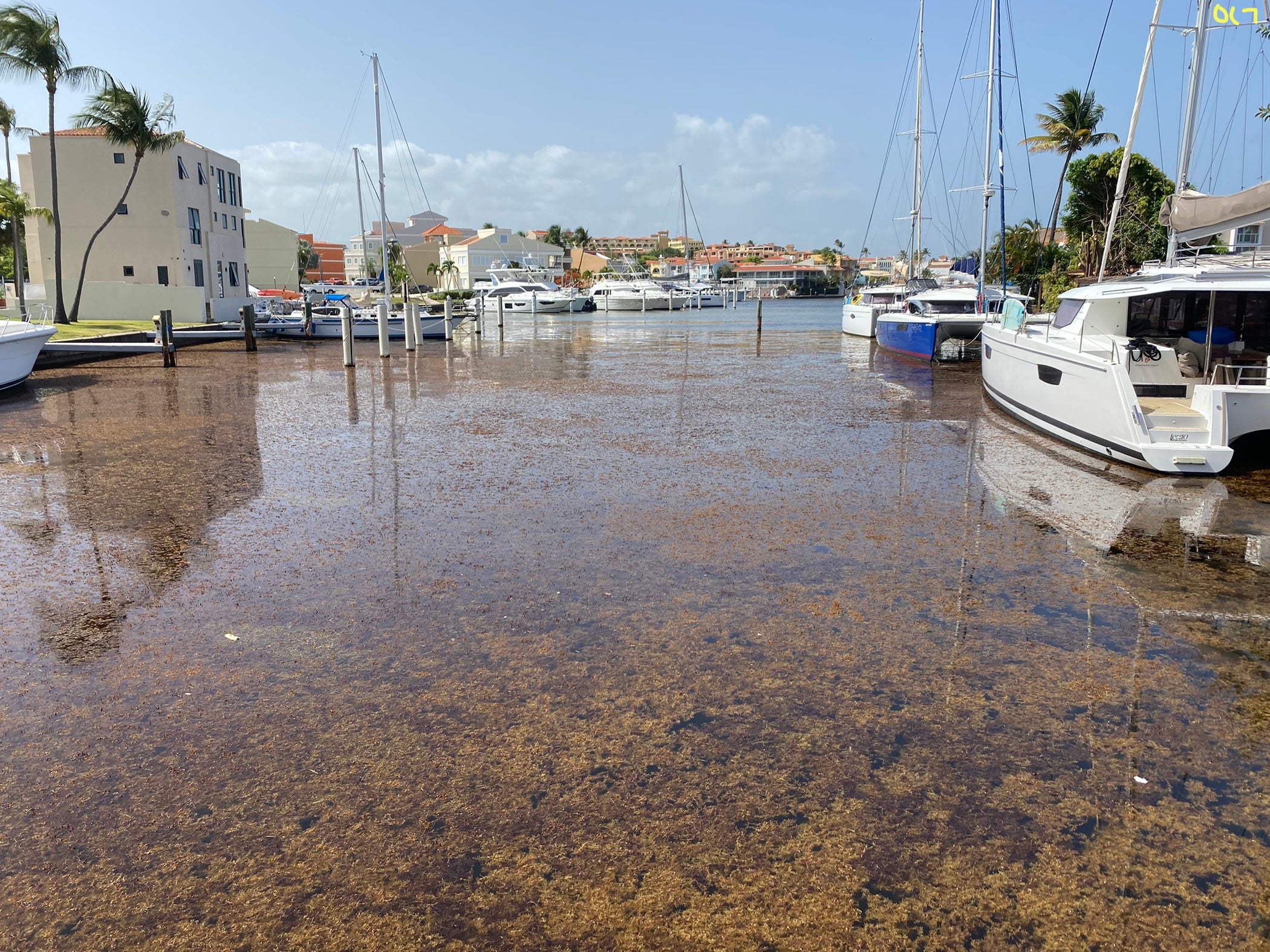
KINGSTON, R.I. – January 28, 2026 – Once a minor presence in maritime records, sargassum – a resilient brown macroalgae found in the Caribbean – has evolved into a growing environmental and economic challenge. A recent study led by University of Rhode Island Professor Tracey Dalton sheds light on the financial toll of recurring sargassum invasions across American coastal zones.
Dalton, alongside Di Jin, a senior scientist at Woods Hole Oceanographic Institution’s Marine Policy Center and URI alumnus, has compiled the most thorough evaluation to date of the economic damage caused by these algal blooms. Their findings reveal annual losses reaching tens of millions, and in certain areas, exceeding a billion dollars, particularly affecting Puerto Rico, the U.S. Virgin Islands, and Florida’s Atlantic shoreline.
Supported by NOAA’s National Centers for Coastal Ocean Science Competitive Research Program, the research fills a crucial gap in understanding how this natural phenomenon impacts regional economies. While prior studies have documented ecological and health-related consequences, this work is the first to systematically measure fiscal burdens on governments, local populations, and private enterprises.
“Although we’ve long known about the environmental disruptions caused by sargassum overgrowth,” Dalton explained, “the financial strain on communities and industries remained unmeasured until now.” She emphasized the need for long-term investment in monitoring systems, predictive modeling, and removal infrastructure, warning that without intervention, economic fallout will intensify.
The project’s foundation was laid by Ken Hamel ’24, Dalton’s former Ph.D. student and now with the USDA Forest Service. With a background in phycology, Hamel brought early attention to seaweed-related challenges during his graduate studies. His collaboration with Dalton led to earlier publications framing sargassum events as emerging natural disasters with wide-ranging consequences.
“Early discussions in our marine affairs program centered on how human activity intersects with marine ecosystems,” Dalton recalled. “Caribbean communities were grappling with health issues, economic setbacks, and social strain, yet comprehensive studies were scarce.”
Dalton and Carlos Garcia-Quijano, a professor of anthropology and marine affairs at URI, had previously conducted fieldwork in the Caribbean, which helped inform the interdisciplinary nature of the current study. Jin’s expertise in economic modeling of harmful algal events strengthened the team’s analytical framework.
Before 2011, sargassum levels in the region were minimal and irregular. However, satellite data confirmed a major bloom that year, marking a shift in patterns. Scientists continue to investigate the combination of climatic, oceanic, and nutrient factors driving these changes.
Published in the latest issue of Harmful Algae, the paper outlines the increasing frequency and duration of sargassum seasons. Data from the Sargassum Watch database confirms forecasts showing earlier onset and extended persistence. In 2025 alone, approximately 38 million metric tons of the seaweed were recorded across the Caribbean, Atlantic, and Gulf of Mexico – a record high.
These accumulations disrupt tourism, fishing, boating, hospitality, real estate, and cruise operations. Physical blockages, foul odors from decomposition, and ecosystem imbalances further compound the challenges.
Risk assessments indicate the highest exposure in Puerto Rico, the Virgin Islands, and Florida’s eastern coastline, including the panhandle. In contrast, Florida’s western shore faces lower risk due to prevailing easterly winds pushing the algae offshore.
In the eastern Caribbean and along Florida’s Atlantic coast, peak risk occurs in May and June. Over recent summers, both the timing and severity of inundations have worsened.
Annual expected direct economic damage is estimated at $2.7 billion for Florida’s east coast, while Puerto Rico and the Virgin Islands face over $100 million in losses each year.
Future research directions include analyzing broader economic linkages, public health implications, and potential beneficial applications of harvested sargassum, such as organic fertilizer, livestock feed, and renewable energy feedstock.
— news from uri.edu
— News Original —
Coastal Atlantic Sargassum impact: Marine Affairs’ Tracey Dalton analyzes economic impact of harmful macroalgal blooms
KINGSTON, R.I. – Jan. 28, 2026 – Sargassum, a hardy brown seaweed in the Caribbean, has been floating through seafarer’s logbooks for centuries, but what impact is it having in the region today? n nIn a new paper, University of Rhode Island Marine Affairs Professor Tracey Dalton and colleagues are updating the current literature about sargassum, with a look at its real economic impact. n nDalton recently published a paper on the algae’s impact with Di Jin, a URI alumnus now a senior scientist at the Woods Hole Oceanographic Institution’s Marine Policy Center. n nTheir paper provides the most comprehensive assessment to date of the economic damage caused by recurring sargassum inundation events across U.S. coastal regions. The research quantifies multi-million dollar, and in some areas potentially more than a billion, in annual losses affecting Puerto Rico, the U.S. Virgin Islands, and Florida’s Atlantic coast. n nFunded by NOAA’s National Centers for Coastal Ocean Science Competitive Research Program, the new study addresses a critical knowledge gap, examining the seaweed’s economic impact. n n“While the ecological and public health impacts of sargassum inundation events have been widely documented,” says Dalton, “their direct and indirect economic costs to governments, coastal communities, and private industries had not previously been quantified.” n n“These results highlight the urgency of sustained investment in sargassum monitoring, forecasting, and cleanup infrastructure,” she says. “Without proactive management, the economic consequences for coastal communities will continue to escalate.” n nDalton credits her former Ph.D. student, Ken Hamel ’24, now working with the USDA Forest Service, for playing a pivotal role in initiating the project. Hamel studied phycology while pursuing his master’s degree so he brought an interest in seaweeds and other algae to URI. The two published related articles on sargassum events, illustrating the seaweed as a significant regional problem with a number of negative impacts. In fact, such events are considered a new type of natural disaster. n n“We spent a lot of Ken’s early days in the marine affairs program talking about the intersection of seaweed and people,” Dalton says. “Communities across the Caribbean were experiencing health, economic, and social impacts from these events, but studies on these impacts were limited.” n nBoth Dalton and her URI colleague Carlos Garcia-Quijano, a professor of anthropology and marine affairs, had done research in Caribbean communities over the years, so the three of them started building a collaborative interdisciplinary study of sargassum impacts on local communities in the Caribbean and brought in Jin at Woods Hole, who has expertise conducting economic impact analyses of harmful algal blooms. n nPrior to 2011, there were small sporadic amounts of sargassum in the Caribbean region, Dalton says, but satellite studies showed the first major sargassum event in the region in 2011. Multiple factors influence the timing and extent of sargassum blooms in the Caribbean, and scientists are still trying to understand how all of these factors contribute to these events. n nTheir paper in the new issue of Harmful Algae documents these rising events in the region, and social and economic disruptions in the area. Using field observations from the Sargassum Watch database, they validate Sargassum forecasts in the region, showing that the sargassum season has started earlier and lasted longer in recent years. In 2025, nearly 38 million metric tons of sargassum were observed in the Caribbean, the Atlantic and the Gulf of Mexico, breaking historical records. Such events can cause considerable physical, ecological and socioeconomic impacts and have negative impacts on human activities such as tourism, hospitality, fishing, lodging, boating, real estate, and the cruise industry. n nThe team’s results will provide important input for deciding the direction of future sargassum response and cleanup. n nRisk levels were shown to be highest in Puerto Rico and the Virgin Islands, along Florida’s eastern coast and panhandle. The risk level was generally low along Florida’s west coast, since the dominant winds blow east to west, away from the shoreline, pushing the sargassum away from the coast. n nIn eastern Florida, Puerto Rico and the Virgin Islands, the sargassum risk level peaks in May or June. n nIn recent years, sargassum inundation has been getting worse each summer, with the season starting earlier and lasting longer. n nDue to the frequency of events, annual expected impacts are higher along Florida’s east coast, with a $2.7 billion direct impact in the region; for Puerto Rico and the Virgin Islands, the annual expected direct impact is more than $100 million. n nFuture studies could examine connections between economic activity and sargassum blooms and other economic impacts including human health concerns. Another dimension is beneficial uses for sargassum, including for fertilizer, animal feed and even biomass for power generation.