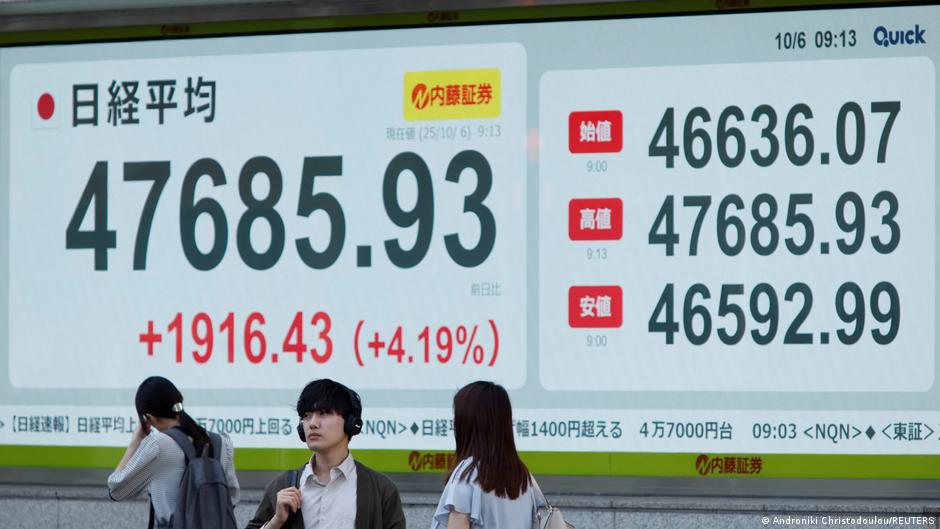
Japanese Prime Minister Sanae Takaichi, 64, has prioritized boosting economic growth while managing rising living costs since assuming office in October. Her administration aims to avoid the short tenure of predecessor Shigeru Ishiba, who stepped down after less than a year amid public frustration over persistent inflation and economic stagnation. Drawing inspiration from former leader Shinzo Abe, Takaichi is advancing a revamped version of “Abenomics,” which combines loose monetary policy, fiscal expansion, and structural reforms intended to break Japan’s long-standing cycle of deflation and sluggish consumption. n nDespite these ambitions, Japan’s economy—the fourth-largest globally—shrank in the third quarter, increasing pressure on Takaichi’s government. In response, her administration recently introduced a $135 billion (€116 billion) spending package aimed at stimulating growth and supporting households. The plan includes direct payments to parents and subsidies for energy costs. n nHowever, experts remain skeptical about its effectiveness. Werner Pasha, a professor emeritus at the University of Duisburg-Essen’s Institute of East Asian Studies, warns that the additional spending could amplify inflationary pressures, particularly over the medium term. He also questions whether the government can execute expenditures quickly, citing past delays in implementation. n nMargerita Estevez-Abe, a Japan specialist at Syracuse University’s Maxwell School, argues that much of the proposed budget resembles a broad wishlist rather than a focused strategy. While Takaichi has pledged investments in AI, semiconductors, biotechnology, space, shipping, and aerospace, Estevez-Abe contends these commitments lack coherence. She emphasizes that Japan’s deeper challenges—such as demographic decline, underinvestment in education, and inefficient capital allocation—are not being adequately addressed. n nThe fiscal outlook adds further complexity. Japan already carries the heaviest public debt among developed nations, standing at approximately 250% of GDP. Yet, it has so far avoided a debt crisis due to favorable debt conditions: all obligations are in yen, and over 90% are held domestically, with more than half owned by the Bank of Japan and other Japanese institutions. Franz Waldenberger, head of the German Institute for Japanese Studies, describes the situation as a “rich country, poor government,” noting Japan’s high net foreign asset position relative to GDP. n nStill, recent economic trends are straining finances. Sluggish growth and increased borrowing have driven up bond yields. The yield on Japan’s 10-year government bond recently reached 1.92%, the highest in nearly 20 years, reflecting rising investor demands for return. Alicia Garcia-Herrero, Natixis’s chief economist for Asia-Pacific, cautions that Tokyo’s aggressive spending resembles “a gambler doubling down on a losing hand,” potentially destabilizing the bond market. n nInflation remains above the central bank’s 2% target. As an import-dependent nation, Japan faces persistent price pressures, exacerbated by a weak yen that increases the cost of foreign goods. Estevez-Abe notes that inflation relief hinges on yen appreciation, which would likely require higher interest rates—a move that could worsen the government’s borrowing burden. The Bank of Japan raised its policy rate from 0.25% to 0.5% in January but has held it steady since, though a further hike is anticipated around December 18–19. n nRising yields have also reignited concerns about the global yen carry trade. For years, investors have borrowed cheaply in yen to invest in higher-return assets abroad, such as U.S. stocks and Treasuries. This strategy depends on low Japanese rates and a depreciated yen. Should rates climb and the yen strengthen, the unwind of this $20 trillion practice could disrupt financial markets, particularly affecting volatile assets like tech equities and cryptocurrencies. Garcia-Herrero describes it as a “global Ponzi scheme” fueling speculative excesses. While a full-scale crisis like 2008 is unlikely, she warns of potential equity losses of 5–12% and bond yield increases of 20–40 basis points. n nPasha views the carry trade as a distorted economic mechanism that has inflated valuations in tech and digital assets. He suggests that a gradual reversal could be beneficial, reducing artificial market exuberance. However, he warns that abrupt shifts in capital flows could trigger instability, though such a financial shock would likely be less damaging than real-world disruptions like trade wars or pandemics. n
— news from DW