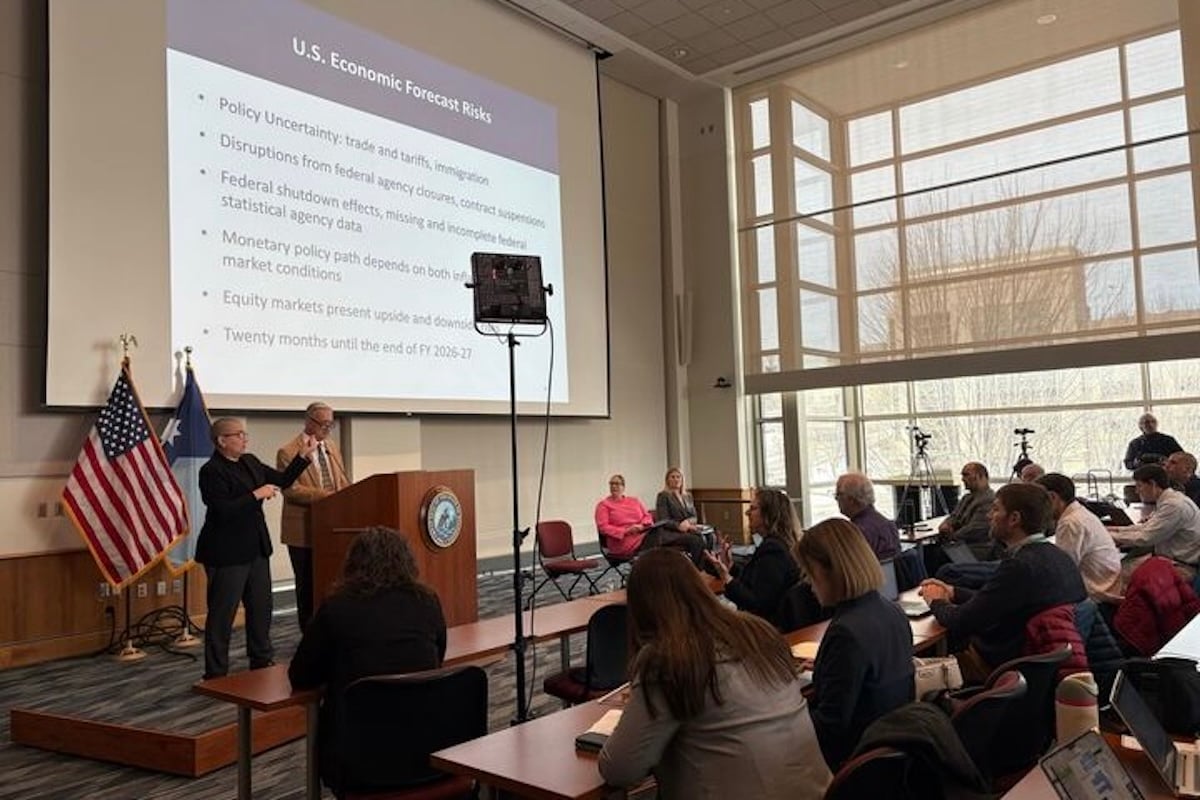
The latest economic forecast from Minnesota Management and Budget reveals a complex fiscal picture, marked by a current surplus but shadowed by future deficits. As of the end of the 2026–2027 biennium, the state anticipates spending $70.3 billion while maintaining nearly $2.5 billion in unallocated funds, bolstered by a $3.5 billion rainy-day reserve. Together, these create a $6 billion surplus highlighted by Senate Majority Leader Erin Murphy, a Democrat from St. Paul. However, projections for fiscal years 2028 and 2029 indicate a shortfall of nearly $3 billion, where expenditures are expected to surpass revenues despite the leftover balance. This marks an improvement from the previously estimated $6 billion deficit, yet it fuels Republican arguments about unsustainable spending patterns.
Chief economist Anthony Becker emphasized that federal policy instability—particularly surrounding trade, tariffs, and immigration—poses the greatest threat to the accuracy of the forecast. Compounding the challenge, the recent federal shutdown disrupted the flow of critical economic data from agencies like Labor and Commerce, impairing the state’s ability to assess inflation and labor market trends accurately. With less reliable national inputs, forecasters had to rely on alternative modeling techniques and delayed statistics.
One of the primary drivers of rising costs is the upward revision of health and human services spending by $1.8 billion, bringing the total to $25.9 billion for the biennium. Of this, $1.3 billion is attributed to increased Medical Assistance outlays, driven by higher enrollment, escalating prescription drug prices, and growing demand for long-term care among elderly and disabled populations. Ahna Minge, the state budget director, identified these cost increases as the most significant factor shaping the financial outlook.
While some Republicans, including House Speaker Lisa Demuth, have pointed to fraud within the Department of Human Services as a contributor to fiscal strain, the official forecast does not quantify such losses. Officials from Governor Tim Walz’s administration argue that rising healthcare costs reflect broader national trends rather than mismanagement or criminal activity. Erin Campbell, commissioner of Minnesota Management and Budget, stated that these increases align with patterns seen in other states and are not indicative of fraudulent behavior.
The forecasting process integrates multiple data sources: national projections from S&P Global Market Intelligence, including over 9,000 variables extending a decade ahead; employment metrics from the Minnesota Department of Economic Development; wage and job figures from the federal Bureau of Labor Statistics; and state tax revenue estimates from the Department of Revenue. Despite its technical complexity, the methodology is widely regarded as nonpartisan and credible by lawmakers across the political spectrum.
Historically, these forecasts have heavily influenced legislative decisions. The optimistic 2022 projection of a $17.6 billion surplus enabled the DFL-led government to expand social programs, including universal free school meals and broader access to subsidized healthcare. In contrast, the more cautious 2025 outlook contributed to delayed budget negotiations and spending constraints, including caps on Medicaid and proposed reductions in special education funding.
Looking ahead, legislators face unprecedented uncertainty due to potential federal shutdowns, evolving Medicaid rules under federal executive actions, and unclear timelines for congressional budget approvals. The so-called One Big Beautiful Bill could cost Minnesota around $500 million in federal Medicaid support, though final guidance won’t arrive until mid-2026, with implementation delayed until 2027. Additionally, possible changes to SNAP benefits and immigration enforcement practices add further unpredictability.
Nan Madden of the Minnesota Budget Project stressed the importance of transparency, urging policymakers and the public to understand both the strengths and limitations of the forecasting model. Patrick Hogan, spokesperson for the budget office, acknowledged gaps in real-time data, particularly regarding the impact of tariffs, which remain difficult to measure due to reporting lags.
As Senator Ann Rest noted, the current level of fiscal ambiguity is unlike anything seen in her nearly four decades in the legislature. With federal support fluctuating and new policy risks emerging, state leaders must navigate a landscape where long-term planning is increasingly challenging.
— news from Eden Prairie Local News
— News Original —
Talking points for all. Amid wild federal uncertainty, here is what to know about Minnesota’s economic outlook.
Guess who said the following about the state’s semiannual budget and economic forecast, put out Thursday by Minnesota Management and Budget. n nStatement A: “The hardworking and brilliant workforce of Minnesotans has built a strong, stable economy, with more than $6 billion in our current surplus and budget reserves. But the actions of Donald Trump and Republicans in Washington threaten all of that good work, and that’s why we’re facing economic instability and a future deficit.” n nStatement B: “If fraud had been taken seriously, instead of dismissing the concern and ignoring massive overruns in spending, that deficit would have been less than a third of what it is now.” n nIt is not a trick question. Statement A comes from Senate Majority Leader Erin Murphy, a DFLer from St. Paul. n nStatement B is Speaker of the House and Republican gubernatorial candidate Lisa Demuth of Cold Spring. n nRelated: Not just vibes: These economic indicators raise concerns about Minnesota’s economy n nThe forecast, which often dictates policy and spending decisions made by governors and legislatures, has always been a dense document where one can cherry pick numbers. n nBut this was especially the case Thursday due to uncertainty about federal actions. n n“First and foremost among the risks to this forecast are the policy uncertainties at the federal level, especially regarding trade, tariffs, and immigration,” said Anthony Becker, chief economist for the state of Minnesota, who addressed reporters at a lecture hall-like room at the Minnesota Department of Revenue. n nThe state also had less data to base its forecast on this time. n n“The recent federal shutdown disrupted the usual collection and dissemination of Federal Statistical data, particularly economic data published by the Labor and Commerce departments, including data on employment and labor GDP and national income accounts and price indices,” Becker said. “The missing data due to the shutdown also clouds our picture of both inflation and labor market conditions.” n nBased on the information it had, the forecast projected that at the end of the biennium — jargon for fiscal years 2026 and 2027 — the state will spend $70.3 billion and still have almost $2.5 billion left over to spend in the next biennium. n nThat $2.5 billion plus a $3.5 billion budget reserve, better known as a rainy-day fund, gives Minnesota the $6 billion surplus alluded to by Murphy. n nBut the projections also show in fiscal years 2028 and 2029, that — even with the projected $2.5 billion lying around — the state will spend almost $3 billion more than it is expected to have on hand. n nThis looming gap between spending and revenue is better than the $6 billion shortfall predicted in the last forecast. But it lends ballast to the Republican claim of runaway spending. n nAs for the accusation of fraud, the forecast makes no mention of the money squandered by the Department of Human Services on scam health care providers, which has led to federal indictments and a pause in payments on 14 Medicaid programs. n nBut it does say that the state has revised upward by $1.8 billion what it expects to spend in the biennium on health care and human services (the total number is now $25.9 billion). This includes $1.3 billion more in spending on Medical Assistance, the state’s Medicaid program. n nAhna Minge, the state budget director, said Thursday that across the board increases in Medical Assistance costs is “the largest driver of the spending forecast.” n nThis is due to higher enrollment, and higher service costs, especially on prescription drugs, Minge said. There is also a rise in long-term care services for the elderly and disabled, which are the most expensive parts of the sprawling Medical Assistance program. n nOfficials with Gov. Tim Walz’s office denied that Medicaid costs are climbing because fraudulent health care providers are cropping up. n nThe cost increases “are what we are seeing in other states and other economic markets,” said Erin Campbell, commissioner of Minnesota Management and Budget. “I would not attribute it to fraud. n nThis is what else to know about this forecast and why it matters. n nHow did Minnesota Management and Budget arrive at these numbers? n nPrior to the publication of the forecast, Minnesota Management and Budget spokesperson Patrick Hogan answered my questions with the caveat, “To be honest, I doubt they would be helpful to your non-economist readers because it’s pretty technical stuff, but that’s the nature of forecasting.” n nSounds like a dare to me. Here is an attempt to make the forecast process palatable to all. n nSo, the budget forecast team looks at four main sets of information. n nThe first is mostly national economic data from Standard & Poor’s Global Market Intelligence, which is a subsidiary of New York-based S&P Global Inc. n nAccording to Hogan, the state has a contract with S&P to provide it “proprietary forecasts and analyses” that “extend nine to 10 years into the future and include forecasts of over 9,000 variables for the U.S.” n nThese include elemental variables like the interest rates set by the Federal Reserve and inflation-adjusted numbers regarding the Gross Domestic Product, consumer spending, personal savings, and whether the U.S. has net exports or imports. n nIt also includes factors timely for the political moment, like the projected impact of deportations and tariffs. n nS&P additionally provides “over 350 variables specific to Minnesota’s economy,” Hogan said. n nThe second major source is Minnesota Department of Economic Development data. This department’s contributions include employment information, like the number of part-time workers who would prefer a full-time job. n nThird is federal Bureau of Labor Statistics numbers on employment and wages. n nAnd, lastly, is the Minnesota Department of Revenue’s tax collection projections, including what the state is expected to generate in the next four years from income, sales, corporate franchise and property taxes. n nIncorporating these different factors is painstaking, but painstaking beats not being seen as credible. Republicans and DFLers interviewed for this story described the forecast as not just influential but above partisan shenanigans (e.g. the forecast team picking data points to make Walz look good). n n“It is a tough job and I really think they do the best they can,” said state Rep. Greg Davids, R-Preston and co-chair of the House Taxes Committee. n nWhat do you mean by influential? n nThe forecast profoundly shapes the decisions made by the Minnesota Legislature. n nThere is no better example than the November 2022 outlook. Released weeks after Walz won reelection and the DFL seized control of both legislative chambers, the forecast trumpeted that “strong collections and lower than projected spending” added $4.6 billion to the general fund bottom line. n nAll told, the 2022 forecast projected a budget surplus of $17.6 billion if revenues and spending kept at their current pace. n nThe DFL was off to the races, spending the 2023 legislative session adding programs like universal free school breakfast and lunch, while also expanding eligibility for unemployment insurance and subsidized health care. n n“When Republicans see a surplus, they think we are collecting too much money for the state government and cut taxes,” said Kurt Daudt, a Republican himself and the former Minnesota Speaker of the House, who retired from the Legislature in 2024. “When Democrats see a big surplus they say, ‘OK, let’s invest in things that will make Minnesota better.’” n nIf the 2022 forecast had been gloomier, Daudt said, DFLers would have been more fiscally conservative, especially as federal Covid money petered out. Instead, the DFL went on to “spend and invest in everything they have ever dreamt of. (An exaggeration. But only slightly.)” n nOn the other hand, the most recent budget forecast, released in February, carried the dire warning of “significant near-term economic and fiscal uncertainty,” with expenses expected to exceed revenues by almost $6 billion when fiscal years 2028 and 2029 roll around. n nThe outlook hung over the 2025 legislative session like a storm cloud. n nRepublicans still cannot finish a sentence without noting that DFLers moved the state from a massive surplus to a looming structural imbalance, which House Floor Leader Harry Niska, R-Ramsey, harped on Thursday. n n“To jump from spending an $18 billion surplus, raising taxes, new mandates, billions of dollars of fraud, to try to blame it all on Trump, requires staggering mental gymnastics,” Niska said. n nThe result was a two-year state budget that was completed three weeks behind schedule and included caps on Medicaid spending, and the intention to slash $250 million in special education moneys. n nBudget forecasts are less important when issued prior to a legislative session (like the upcoming one) when there is no two-year state budget to pass. n nBut according to Sen. Ann Rest, DFL-New Hope and chair of the Senate Taxes Committee, the even-yeared forecasts are still critical, because they determine if the Legislature must pass a supplemental budget, or a tax bill responsive to new revenue projections. n nWhat is different about this forecast? n nRest has served in the Legislature since 1985. She said that she has never seen the extent of fiscal uncertainty Minnesota faces today, largely because of the erratic nature of federal funding. n n“The way the forecast is done,” Rest noted, “there is a positive, neutral, and pessimistic outlook” but it is harder to quantify the scope of unknowns that can prevent lawmakers from making informed decisions. n nOne variable is whether the federal government shuts down again at the end of January, and when or if Congress advances a 2026 budget. n n“How do you plan around that?” Rest said. “In past years, the federal budget was passed, and you counted on that money.” n nAnother issue is the impact of the One Big Beautiful Bill. n nThe Walz administration declared that Minnesota stands to lose around $500 million in Medicaid funding because of the measure. However, the U.S. Health and Human Services is not set to issue guidance on new Medicaid eligibility restrictions until June, and the changes themselves will not come into effect until 2027. n nThere are also Trump administration executive actions to track. n nRelated: How’s Minnesota’s economy? The answer depends on your income bracket n nThese include threatened cuts to the Supplemental Nutrition Assistance Program, whether the University of Minnesota stays in the good graces of Education Department officials, and if Twin Cities businesses are raided in pursuit of Somali immigrants or other targets. n n“It will be really important to use additional sources of information to understand things like what it would it take for the state to prevent a massive loss of health coverage in Medicaid and prevent an increase in hardship and hunger from changes to SNAP,” said Nan Madden, director of the Minnesota Budget Project, a nonprofit research and advocacy group. n nHogan at the budget office admitted there are areas of uncertainty. In fact, he elaborated on one more — the effect of tariffs. n n“We currently have a working group focused on how tariffs impact Minnesotans. Unfortunately, economic data is produced with a significant lag, so it is often difficult to parse out impacts until after the fact,” Hogan said. “The level of detail needed to fully understand something like this is not readily available.” n nSaid Madden, “Because of some unique circumstances right now, it will be especially important for policymakers, media, and the public to understand what the forecast methodology does and does not include.” n nEditor’s note: This article first appeared on MinnPost and was written by state government reporter Matthew Blake. It is republished here with permission under a Creative Commons Attribution-NoDerivatives 4.0 International License. n nMinnPost is a nonprofit, nonpartisan newsroom dedicated to producing high-quality journalism for Minnesotans.