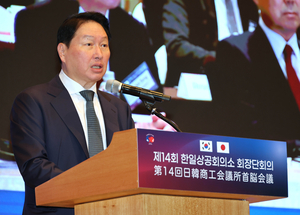
Chey Tae-won, chairman of both the Korea Chamber of Commerce and Industry (KCCI) and SK Group, has intensified his push for a robust economic alliance between South Korea and Japan, drawing comparisons to the European Union’s integration model. Speaking at the annual KCCI-Japan Chamber of Commerce and Industry (JCCI) meeting held on Jeju Island, Chey emphasized that both nations face overlapping internal and external pressures requiring coordinated strategies.
Externally, he highlighted the shifting global trade landscape and intensifying competition in advanced technologies. Domestically, both countries are grappling with structural issues such as declining fertility rates, an aging populace, and the economic stagnation of rural regions. To address these, Chey urged moving beyond traditional collaboration toward co-designing future frameworks.
He proposed joint initiatives such as shared energy procurement to reduce dependency risks and mutual utilization of healthcare infrastructure to manage demographic strains, which could lower public spending and social burdens. Another suggestion included establishing a passport-free travel zone akin to Europe’s Schengen Area to stimulate tourism and cultural exchange.
Chey has recently amplified his vision of a Seoul-Tokyo economic bloc, arguing that combining the two economies would create a $6 trillion market—ranking it as the world’s fourth-largest. Such a union, he believes, would enhance global competitiveness and open new commercial pathways.
Ken Kobayashi, head of JCCI, supported this outlook, noting that rising protectionism—exemplified by recent U.S. tariff policies—is disrupting the global economic order and increasing geopolitical volatility. For export-reliant nations like Japan and South Korea, maintaining and strengthening free trade systems is critical for sustained growth.
Kobayashi acknowledged the historical rivalry between the two countries but expressed hope for a shift toward partnership. He pointed out that both face similar societal trends, including shrinking populations, and stressed the importance of transitioning from competition to joint problem-solving.
The meeting concluded with a joint declaration outlining cooperation in artificial intelligence, semiconductors, and energy—sectors deemed vital for national competitiveness. Both chambers committed to fostering stable investment climates and resilient supply chains. They also agreed to expand collaboration on demographic challenges and increase cross-border engagement in tourism, culture, and broader economic activities.
— news from The Korea Herald
— News Original —
SK chief doubles down on Korea-Japan economic bloc push
Chey Tae-won, chair of the Korea Chamber of Commerce and Industry and SK Group, has doubled down on his calls for closer economic cooperation between South Korea and Japan — comparable to EU-level integration — in order to jointly tackle global trade shifts and demographic challenges. n nSpeaking at the annual executive meeting between the KCCI and the Japan Chamber of Commerce and Industry held on Jeju Island, Chey noted that the two countries face “common challenges inside and out,” stressing the need for tighter cooperation between the neighbors. n n“Externally, we have to respond to the global business environment and competition in cutting-edge technologies, while internally, both countries have many structural problems that need to be solved, such as low birth rates, aging population and regional decline,” Chey said in his opening address. n nHe stressed that the two countries need to move beyond simple cooperation and start designing the future together, calling for the courage to gather ideas from tangible areas and test them. n n“For instance, both energy-dependent South Korea and Japan can jointly procure energy together, or share medical system (infrastructure and services) to address low birth rates and aging populations, so that we can ease fiscal and social costs,” he said. n nHe also floated the idea of passport-free travel between the two countries, similar to Europe’s Schengen Agreement, to boost tourism. n nChey in recent months has stepped up his advocacy for creating an economic bloc between Seoul and Tokyo, like that of the EU, to confront shared challenges and external uncertainties. He argues that a combined Korea-Japan market would be around $6 trillion, making it roughly the world’s fourth-largest economic bloc, with the capability to expand business opportunities. n nJCCI Chair Ken Kobayashi echoed Chey’s view that the two countries need to cooperate to tackle shared demographic and economic headwinds. n n“Protectionist measures such as recent US tariff actions are affecting the international economic order and heightening geopolitical risks, adding to global uncertainty,” said Kobayashi. “For trade-oriented countries like Japan and Korea to continue to develop, preserving and advancing a free trade system is essential.” n nKobayashi added that both countries face shared social challenges, including declining birth rates and shrinking populations. “Korea and Japan have long operated in a competitive framework, but I hope the coming era will be one in which we move toward cooperation.” n nAt the meeting, the two chambers issued a joint statement, pledging cooperation in artificial intelligence, semiconductor and energy — sectors they both described as key to strengthening the countries’ competitiveness. The two vowed to establish stable investment environments and supply chains in these areas. They also agreed to expand collaboration in addressing low birth rates and population decline, while boosting exchanges across the economy, tourism and culture. n nsahn@heraldcorp.com